
If you’re searching for a smarter, more sustainable way to improve your health, you’re likely tired of fragmented advice that treats fitness, nutrition, sleep, and mindset as separate goals. Real, lasting transformation doesn’t come from isolated hacks—it comes from building strong total fitness foundations that support your body and mind every single day.
This article is designed to give you a clear, structured path toward health optimization, strength conditioning, daily wellness routines, and sleep optimization strategies that actually work together. Instead of quick fixes, you’ll learn how to create systems that improve energy, resilience, recovery, and long-term performance.
Our approach is grounded in evidence-based training principles, proven conditioning protocols, and practical wellness frameworks used by high performers. We’ve studied the science, tested the routines, and refined the methods so you can skip the confusion and focus on what truly moves the needle.
If you’re ready to build a stronger, healthier, more optimized version of yourself, this guide will show you how.
Your Blueprint for Deep, Restorative Sleep
You spend eight hours in bed, yet wake up exhausted. That’s the real problem: poor sleep quality quietly sabotages your energy, focus, mood, and physical progress. Deep sleep—the stage where muscle repair, memory consolidation, and hormone regulation occur—must be rebuilt intentionally.
This isn’t another generic checklist. It’s a structured system rooted in proven sleep optimization strategies that support recovery at a cellular level (yes, that detailed).
Core pillars include:
- Consistent sleep-wake timing
- Light exposure management
- Temperature and environment control
- Pre-sleep nervous system downshifting
Follow this step-by-step blueprint to unlock consistently restorative sleep.
Engineer Your Perfect Sleep Sanctuary
To truly maximize your daily performance, it’s essential to integrate effective sleep optimization strategies, which you can also complement with insights from our comprehensive Fitness Guide to Wellness – for more details, check out our Fitness Guide Ontpwellness.
Great sleep isn’t luck. It’s environment by design.
The Darkness Protocol
Light is a biological signal. Even faint light can suppress melatonin—the hormone that regulates your sleep-wake cycle (Harvard Health Publishing). Absolute darkness tells your brain it’s time to power down.
A vs B:
- A dim room with glowing LEDs
- A cave-like space with zero light leaks
The second wins. Install blackout curtains, cover every electronic indicator (yes, even that tiny charger light), and use a high-quality sleep mask if needed. (Your brain can’t ignore light just because you can.)
The Temperature Target
Your body initiates sleep by lowering its core temperature. Research shows the ideal range is 60–67°F (15–19°C) (Sleep Foundation).
Warm room vs cool room? A warm room fights your biology. A cool room supports it. Set the thermostat lower or use breathable bedding to help your body shift into sleep mode faster.
The Sound Strategy
Noise fragments sleep cycles—even without fully waking you (National Institutes of Health).
Silence vs sudden sound spikes? Consistency wins. Try:
- Earplugs
- A white noise machine
- A steady fan hum
These small sleep optimization strategies compound into deeper, more restorative rest.
Master Your Day to Conquer Your Night
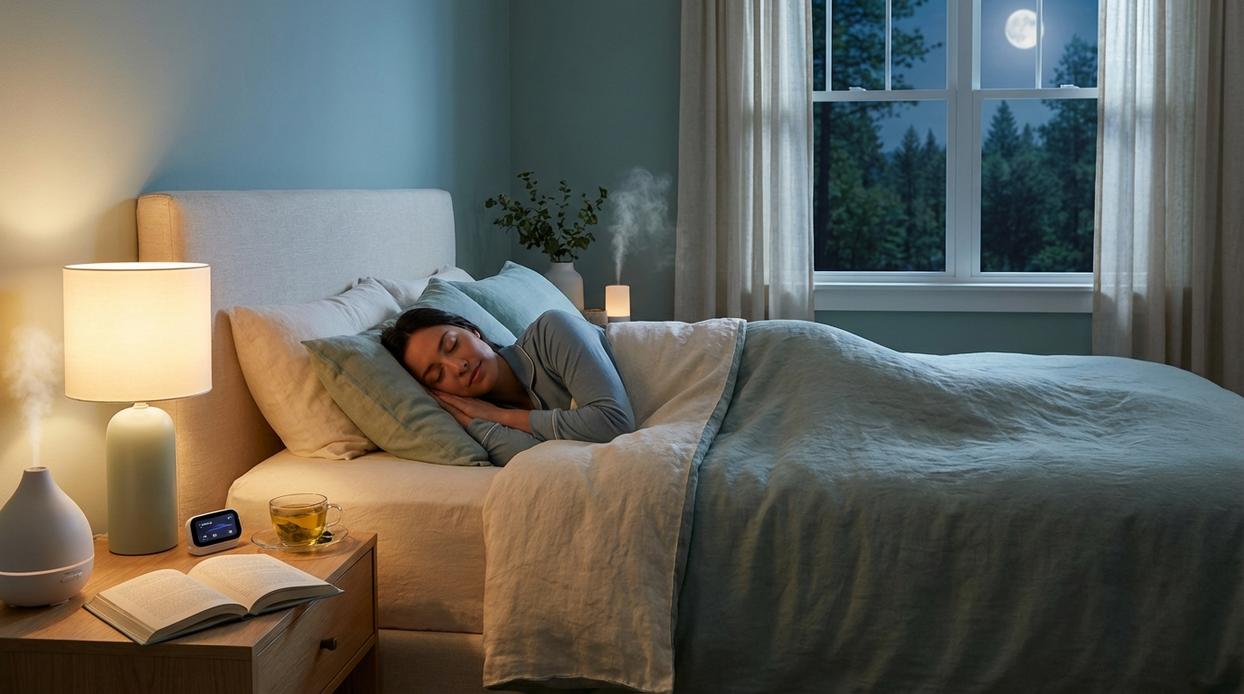
If your sleep feels like a chaotic Netflix autoplay spiral at 2 a.m., the fix starts when your alarm goes off. Your body runs on a circadian rhythm—an internal 24-hour clock that regulates sleep, hormones, and energy. The fastest way to stabilize it? A consistent wake-up time. Yes, even on weekends. Sleeping in two extra hours on Sunday creates social jet lag (basically flying from New York to Denver and back—without leaving your bed).
Within the first hour of waking, get 10–15 minutes of direct sunlight. Morning light tells your brain to suppress melatonin (the sleep hormone) and start the day’s timer. Think of it like hitting “Start Mission” in a video game—the countdown to quality sleep begins immediately. Cloudy day? Still go outside. Natural light beats indoor lighting by a mile.
Daily movement builds sleep pressure—your body’s biological need for rest. Exercise helps, but timing matters. Finish moderate-to-intense workouts at least three hours before bed so your nervous system can power down. A late-night HIIT session might leave you feeling like you just drank rocket fuel (not ideal at 10 p.m.).
Now for the hard truth: THE CAFFEINE CURFEW. Cut off coffee, tea, soda, and energy drinks 8–10 hours before bed. Caffeine’s half-life—the time it takes for half of it to leave your system—is about 5–7 hours, according to the Sleep Foundation. That 3 p.m. latte? Half of it may still be circulating at bedtime.
Master these sleep optimization strategies daily, and your nights will stop feeling like a battle and start feeling automatic.
The Ultimate Pre-Sleep Wind-Down Routine
If you want better sleep, you need a better ending to your day. Think of this as your nightly shutdown sequence (yes, like powering down a laptop—except you’re the hardware).
1. Start a “Digital Sunset”
First, set a firm rule: all screens off 60–90 minutes before bed. Phones, TVs, tablets—everything. Blue light (a high-energy light emitted from screens) suppresses melatonin, the hormone that signals your body it’s time to sleep (Harvard Health Publishing). When melatonin drops, your brain stays wired.
Instead, switch to low, warm lighting and analog activities like reading or light stretching. Pro tip: set a recurring alarm labeled “Digital Sunset” so you don’t rely on willpower alone.
2. Do a 5-Minute Relaxation Practice
Next, calm your nervous system with box breathing. Inhale for 4, hold for 4, exhale for 4, hold for 4. Repeat for five minutes.
This technique regulates the autonomic nervous system (the system controlling stress responses), lowering heart rate and promoting relaxation (Cleveland Clinic). If your mind wanders, gently bring it back to counting. That’s the practice.
3. Perform a “Brain Dump”
If your thoughts race the second your head hits the pillow, try this: spend five minutes writing down every task, worry, or idea. This “cognitive offloading” clears mental clutter so your brain doesn’t rehearse tomorrow at midnight.
4. Use Temperature to Your Advantage
Finally, take a warm shower or bath about 90 minutes before bed. The rise in body temperature followed by a rapid cool-down signals sleep onset (National Library of Medicine). It’s one of the simplest sleep optimization strategies available.
For deeper insight into how recovery ties into hormones, read hormonal health and exercise what you need to know.
Consistency turns routines into results. Start tonight.
Mind Your Last Meal
Finish dinner at least three hours before bed. Late, heavy, or spicy meals—think Nashville hot chicken or a greasy food-truck burrito—can trigger reflux and fragment sleep. In Ozdikenosis-style sleep optimization strategies, timing matters as much as macros. Your body repairs at night, not digests feasts.
A Note on Hydration
Hydrate well through the day, then taper fluids 1–2 hours before bed to limit wake-ups.
Sleep-Supportive Nutrients
Incorporate magnesium- and tryptophan-rich foods as part of a balanced plan:
| Food | Key Nutrient |
|---|---|
| Almonds | Magnesium |
| Turkey | Tryptophan |
| Tart cherries | Natural compounds |
Small shifts, measurable rest.
High-quality sleep is not a luxury; it is a biological necessity that drives recovery, focus, hormone balance, and long-term resilience (CDC). In other words, it’s the foundation beneath every health goal you have.
So, how do you take control? By consistently applying proven sleep optimization strategies across three core areas:
- Environment: Cool, dark, quiet spaces support deeper REM cycles.
- Daily rhythms: Consistent wake times regulate your circadian clock.
- Evening habits: A “Digital Sunset” reduces blue light exposure and melatonin disruption.
Now, here’s your move: choose one strategy—just one—and start tonight. Small shifts, repeated daily, create transformative results.
Build the Stronger, Healthier Version of You
You came here looking for a clear path to better fitness, smarter health optimization, and sustainable strength—and now you have it. From building total fitness foundations to implementing structured conditioning protocols and sleep optimization strategies, you understand what it truly takes to create lasting results.
The real frustration was never a lack of effort. It was not having a proven, structured system that connects your workouts, recovery, and daily wellness into one powerful plan. Without that structure, progress feels slow, inconsistent, and exhausting.
Now you know the difference: when strength training, recovery, daily routines, and mindset work together, your body responds faster and more efficiently.
Here’s your next move—don’t let this clarity turn into delay. Take action today by implementing a structured health optimization plan designed to eliminate guesswork and accelerate results. Join a proven system trusted by driven individuals who are serious about transforming their strength, energy, and overall performance.
If you’re ready to stop spinning your wheels and finally see measurable progress, start now. Commit to the plan, follow the protocol, and take control of your total fitness foundation today.