Hitting a performance plateau can be frustrating—especially when you’re putting in the work but not seeing improvements in quickness or reaction time. Many athletes build strength but overlook the movement mechanics that truly unlock explosive speed and agile transitions. This guide is designed to change that. Grounded in proven strength conditioning protocols and total fitness foundations, it delivers a clear, actionable plan to sharpen your edge. You’ll get a curated list of targeted speed development drills and agility-focused exercises that directly enhance acceleration, control, and responsiveness—so you can start improving your performance today.
The Foundation: Why Proper Mechanics and Warm-Ups Are Non-Negotiable
Speed isn’t magic—it’s mechanics. It comes down to stride length (how far you travel per step) and stride frequency (how fast your feet cycle). Improve both, and you move faster. Targeted speed development drills sharpen neuromuscular timing so each ground contact produces more force with less wasted motion (think less “flailing,” more precision like a sprinter in slow motion replay).
Agility is often misunderstood. It’s not just quick feet; it’s the ability to decelerate, change direction, and re-accelerate efficiently. The hidden driver? Eccentric strength—your muscles’ ability to absorb force under tension. Without it, cuts feel sloppy and joints take the hit.
The real edge competitors miss: the central nervous system. A dynamic warm-up primes neural pathways for explosive output while reducing injury risk (studies show proper warm-ups lower strain incidence, per NSCA guidelines).
Sample 5-Minute Warm-Up:
- High Knees
- Butt Kicks
- Walking Lunges with a Twist
- Leg Swings (forward and lateral)
Pro tip: Treat warm-ups as performance training, not a checkbox.
Building Raw Speed: Foundational Drills for Linear Acceleration
Acceleration is like launching a rocket: the first few seconds determine how far and how fast you’ll go. In sprinting, the first 10–20 yards are that launch window. These speed development drills sharpen your ability to apply force straight into the ground and project your body forward with intent.
Exercise 1: Wall Drills
Think of this as rehearsing your takeoff against a launchpad. Set up by leaning into a wall at roughly a 45-degree angle, forming a straight line from head to heel. Drive one knee powerfully toward your chest while keeping your core braced. This isolates acceleration mechanics—teaching your body what a proper forward shin angle and explosive push feel like. Some argue wall drills are too static to matter. But like practicing a golf swing in slow motion, precision builds patterns before speed magnifies flaws.
Exercise 2: A-Skips
A-Skips are sprinting’s metronome. Drive the knee up, dorsiflex the foot (toes up), and create a sharp “pop” off the ground. The cyclical leg action reinforces rhythm and elastic rebound. Critics may say skips look elementary. Yet coordination is the wiring behind power—without it, strength leaks away like air from a tire.
Exercise 3: Resisted Sprints
Using a sled or resistance band, sprint 10–20 yards with controlled resistance. The goal isn’t slowness; it’s maximal force per stride. Picture pushing a stalled car—every step demands intent. Over time, apply progressive overload techniques for sustainable strength growth to increase resistance gradually (pro tip: keep posture identical to unresisted sprints).
Mastering Agility: Drills for Rapid Change of Direction
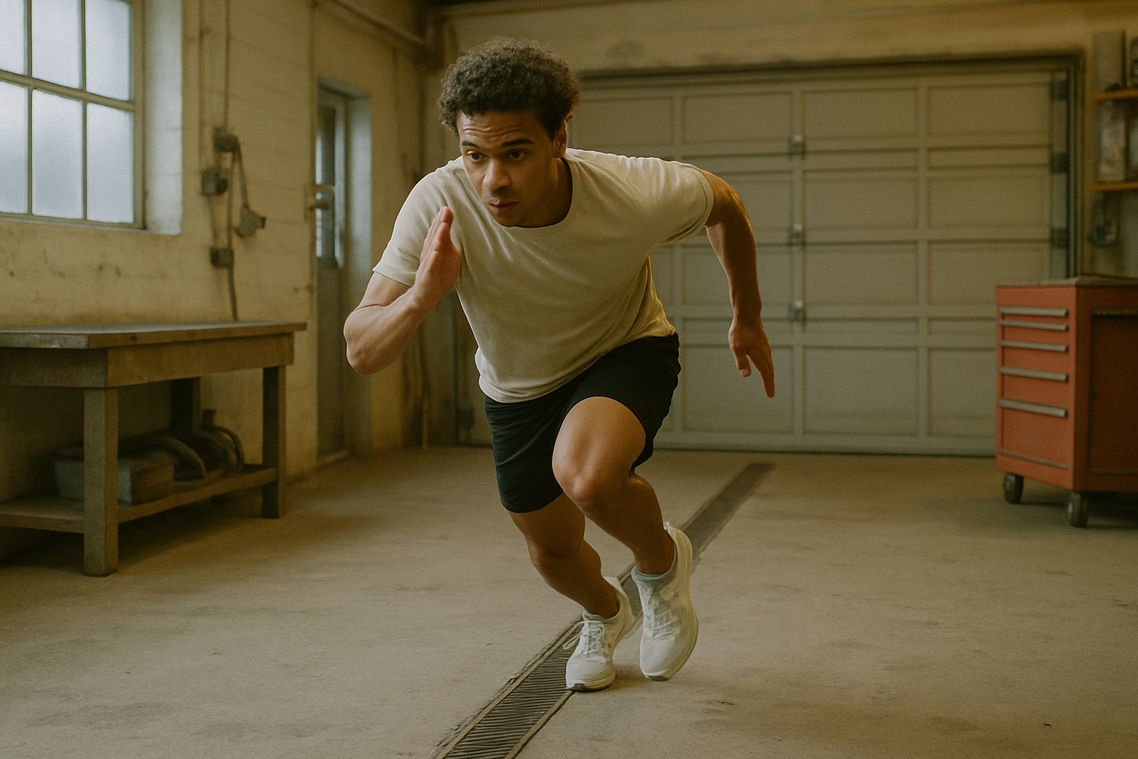
Agility isn’t just about moving fast—it’s about stopping, absorbing force, and exploding in a new direction. In other words, it’s controlled chaos. The following drills sharpen that ability, but each develops it differently.
Exercise 1: 5-10-5 Pro Agility Shuttle
Set three cones in a straight line, each 5 yards apart. Start at the middle cone. Sprint 5 yards to one side and touch the line with your hand. Then explode 10 yards to the far cone and touch again. Finally, sprint back 5 yards through the middle to finish.
The key? Lower your center of gravity (how low your hips sit relative to the ground) before each cut. Plant your outside foot hard and drive off it. Compared to the Box Drill, this shuttle is more reactive and emphasizes sharp, aggressive turns over movement variety. If you want pure change-of-direction speed, this is your go-to.
Exercise 2: Box Drill
Place four cones in a square, each 5–10 yards apart. Sprint forward, lateral shuffle right, backpedal, then shuffle left to return to the start.
Unlike the 5-10-5, this drill builds multi-directional competency. You’re not just cutting—you’re transitioning between movement patterns. Think of it as cross-training for your footwork (more chess match than drag race).
Exercise 3: Agility Ladder – Icky Shuffle
Using an agility ladder, perform the “in-in-out” pattern: two feet inside a square, one foot outside, then repeat down the ladder. Stay on the balls of your feet and minimize ground contact time.
Compared to cone drills, ladder work refines rhythm and coordination—foundational qualities that enhance speed development drills. Pro tip: stay relaxed in your shoulders; tension slows turnover.
Together, these drills don’t compete—they complement. Train all three, and your cuts will feel automatic.
Programming for Success: How to Integrate Drills Into Your Routine
The golden rule is simple: perform speed and agility drills when you’re fresh. That means right after a thorough warm-up but before heavy lifting or conditioning. Your nervous system adapts best to high-quality reps, not exhausted ones (yes, even if you “feel” tough).
A simple weekly template works: Day 1—Speed Focus with wall drills and resisted sprints; Day 3—Agility Focus with ladder drills and the box drill. Start with 3–4 sets of each movement, exploding for 5–10 seconds or 10–20 yards, then rest 60–90 seconds. Recovery keeps output high.
Progress gradually. Increase execution speed, reduce ground contact time, or add a reactive cue like a partner pointing directions. This builds responsiveness.
Some argue conditioning first saves time. But quality beats fatigue for speed gains. Pro tip: film reps to spot technical leaks. Use speed development drills consistently and track results.
Incorporating speed development drills for explosive power can not only enhance your athletic performance but also complement the technical prowess discussed in our article on how to optimize the Bikimsum processor for peak efficiency – for more details, check out our How To Bikimsum Processor.
From Plan to Performance: Execute Your First Session
You came here to learn how to build real speed and agility—and now you have a complete toolkit to do exactly that. The frustration of feeling a step too slow isn’t a life sentence. It’s a trainable quality, and you now understand that elite quickness comes from precise execution of foundational speed development drills, not endless volume.
Progress begins with action. Choose one speed drill and one agility drill from this guide and perform three focused sets of each after your next warm-up. Commit to sharp, intentional reps.
If you’re ready to stop feeling behind and start moving with confidence, take that first step today. Your faster, more explosive self is built one session at a time.